


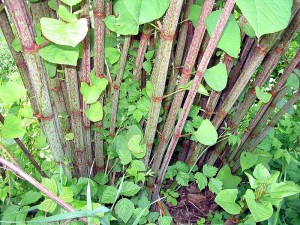
 Polygonum cuspidatum
Native range: Japan, China, and Korea
Invasive range: Throughout North America and Europe
Habitat: Riverbanks to roadsides, often in dense clumps where little other vegetation can survive.
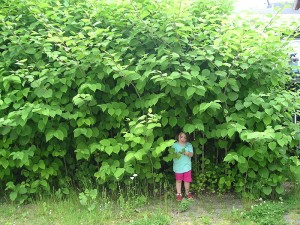
Description: Fast-growing and aggressive perennial that can reach 6 or 7 feet in height. Mostly spreading through rhizomes, or roots, shoots can sprout through heavy mulch and even asphalt. Leaves are alternate, egg shaped; stems are hollow. Small white flowers bloom in late summer. The fruit, a single seed within a three-winged calyx, remains on the stem for a short time after senescence. The young shoots are edible.
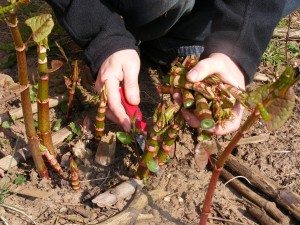
Japanese knotweed shoots (via selfsufficientish.com)
It’s the 1880s. Frederick Law Olmstead, who, in his thirties, co-designed a little patch of ground in New York called Central Park, in his forties sells Boston on the Emerald Necklace, a whole new park system––and, in the process, he plants miles of parkway with a brand new import he thinks pretty and perfect for hedges, windbreaks, and erosion control. Olmstead was an abolitionist journalist. He invented landscape architecture. He made the case for preserving Yosemite Valley as a public park. He chose Japanese knotweed to line his highways. He made a big mistake. He’s not the only one.
It’s 2002. The forager Steve Brill calls knotweed “one of the premier wild foods of early spring. It is so abundant and invasive that gardeners and landscapers detest it.” Others are not so kind: this “fearsome colonizer of the peaceful lands” as the Brits call it (they should know) easily makes the Global Invasive Species List of the 100 worst invasives.
Knotweed grows fast; this clip shows one meter of growth in only three weeks. So within days it will go from tender to tough; catch it while it resembles what Brill calls a “fat, reddish asparagus stalk.” Last year’s dead stalks likely mark dense stands of new shoots. This is the best time to harvest it, though you can eat shots up to 1′-2′ tall, provided you remove the leaves and peel the bark. Related to rhubarb, it’s very sour and may act as a laxative the way rhubarb does, so use it sparingly at first.
Most importantly, be sure that any harvesting of Japanese knotweed does not result in its spread. Pieces of rhizome can stay dormant for years before sprouting. Never add knotweed to your compost or send it to a municipal compost center.
Dandy Knotweed Muffins
From Blanche Cybele Derby
author of My Favorite Plants
The best time to gather young knotweed shoots, up to about 8 inches, is in early spring. (The larger ones are tough and stringy.) Here in Massachusetts, that’s usually the end of April, though this year they were a few weeks early. Collect young Japanese knotweed stalks, up to about 8 inches. They grow like crazy, so you have to be johnny-on-the-spot to get them before they’re too high. Some people peel the outer skin off the shoots, but that can be tedious, and if you’re not careful, you may peel too much off, so I usually don’t bother.
Makes 16 large muffins
Japanese knotweed stalks to measure 2 cups, minced
1.5 cups flour
0.5 cup dandelion flower petals, stripped from their base (do not include any green parts)
1 teaspoon baking powder
1 teaspoon baking soda
0.5 cup softened butter
1 cup light brown sugar
2 eggs
1 teaspoon vanilla
1 cup sour cream or yogurt
Snip off the pointy tops of the knotweed stalks and mince.
Combine flour, dandelions, baking powder, and baking soda in a small bowl.
Cream 0.5 cup butter with 1 cup brown sugar until fluffy. Beat in eggs one at a time and then add the vanilla. To this mix, alternately fold in the sour cream and dry ingredients until blended. Fold in the knotweed pieces. Divide the batter into greased muffin forms.
Bake at 350˚F for 15 to 20 minutes, until the muffins test done in the center.
Note:
This recipe can be adapted to use 1/2 rhubarb & 1/2 knotweed and if dandelion petals aren’t available, pull apart red clover flowerheads and use those individual pieces. Feel free to experiment!
Knotweed Wine
4 lbs (2 kg) knotweed stems, cut into chunks and leaves removed
3 lbs (1.5 kg) sugar
1 t yeast nutrient
juice of 1 orange
wine yeast (all-purpose yeast will do, but champagne yeast preferred)
enough water to make up to 1 gal (4.5 liters)
Put knotweed into a straining bag, and put bag into a sterilized bucket.
Bring the water, sugar, orange juice, and yeast nutrient to boil and pour onto bag in bucket.
Let stand, covered, till cool.
Activate the yeast and add it to the bucket.
Keep the bucket covered for about a week, till the fermentation dies down a little.
Decant into a demi-john.
Treat as for other wines from here––though if your wine retains a vibrant pink at this point, stabilizing it with sulfite when bottling it will make the hue vanish.
Steve Brill’s Japanese Knotweed Sherbet
Japanese knotweed shoots, peeled if longer than 8″ and coarsely sliced
1 1/3 c orange juice (freshly squeezed is best)
1 1/2 c apple juice or other unsweetened fruit juice
1/2 c lemon juice
1/4 c canola oil
1/4 c vegetable glycerin, honey, barley malt, or rice syrup
1 T freshly grated orange rind
2 t vanilla extract
1 t lemon extract
1 t liquid stevia (optional)
1/2 t salt
1. In a medium saucepan, simmer knotweed shoots in orange, apple, and lemon juice over medium heat, covered, until shoots are tender, about 10 min.
2. Transfer knotweed and juices to blender, and remaining ingredients, and process until smooth.
3. Chill mixture until cold (1 hr in freezer or 4 hrs in fridge).
4. Pour mixture into ice cream machine and freeze according to manufacturer’s instructions.
Makes 5 cups; serves 5.
Strawberry knotweed pie
Adapted from Wild Plants I Have Known and Eaten by Russ Cohen.
Young, spring Japanese knotweed tastes similar to rhubarb, and makes a perfect partner with seasonal fresh strawberries in this beautiful pie. Knotweed first appears in April, and by May the young stalks of 1 to 2 feet high are ready to harvest by cutting just about the woody base and removing the leaves. This is a recipe for a two-crusted pie, but we’ve also made it using only a top crust and that works nicely as well.
Makes a 9-inch pie
3-plus cups sliced strawberries
3-plus cups peeled, sliced Japanese knotweed stalks (cut stalks in half lengthwise to reduce any trapped air space inside, and then in 3/4- to 1-inch pieces, as you would cut rhubarb)
1 cup sugar
1/2 teaspoon ground nutmeg
1 teaspoon cinnamon
1/2 teaspoon ground allspice
Flour, as needed for filling and rolling
Dough for crust (below)
1. Preheat oven to 425 degrees. Mix the filling ingredients together in a bowl; if runny juice accumulates in the bowl, stir a tablespoon or so of flour into the filling to help absorb it.
2. Spread out one ball of dough with the base of your hand, then use a rolling pin to roll it out to approximately 1/8-inch thick, adding flour to the pin, counter, and/or dough if they get sticky – or roll the dough between 2 sheets of wax or parchment paper dusted with flour. Place in the pie plate. Pour filling into the pie plate. Repeat the process with the second ball of dough and cover filling (or cut into 1/2-inch strips and place over filling in a lattice pattern).
3. Place on a cookie sheet and bake for 20 minutes at 425 degrees, then 25 minutes more at 400 degrees. The pie is done when the filling bubbles over and the crust is golden. If the pie crust is getting too brown in one or two places before the rest is done, place a small piece of aluminum foil over that spot to slow the browning.
Dough for crust
1 2/3 cups all-purpose flour
Pinch of salt
5 tablespoons cold butter
5 tablespoons vegetable shortening or lard (or all butter, if preferred)
7 tablespoons cold apple or orange juice
1. Pour flour and salt into a food processor. Dice butter into small pieces and cut shortening into big pieces and add to processor, and pulse until coarsely chopped (small lumps are okay). Add cold juice and pulse until it begins to ball up.
2. Shape into two balls, wrap in wax paper or plastic wrap, and refrigerate for 30 to 60 minutes.
Other Recipes from Russ Cohen and the New England Wildlife Society
Applesauce-Knotweed Cake
Go Anywhere Knotweed Squares
Sour Cream Knotweed Crumb Cake
Andy Hamilton’s Japanese Knotweed Vodka
Recipes for Itadori
Japanese knotweed, or itadori as it is known in Japan, is enjoyed throughout its native country. Here are two traditional recipes.
Shikigami: Where the Wild Things Are
Shizuoka Gourmet



{ 9 comments… read them below or add one }
I’ve made quite a few knotweed recipes, it’s probably my favorite invasive to chow down on!
Far and away my favorite though is the Knotweed Gazpacho recipe I made (and continue to make) every spring.
Knotweed, Cucumber & Avocado Gazpacho (serves 2 for lunch)
3 cups roughly chopped Japanese knotweed, peeled if needed
2 cucumbers,
1 jalapeno, seeded and sliced
1 avocado, diced
1 cup quality veggie stock or broth
3 cloves of garlic, sliced
1/2 roughly chopped, green bell pepper
handful of roughly chopped cooked shrimp, optional
black pepper
olive oil
1. Saute the garlic in olive oil until fragrant, about 1-2 minutes, do not brown.
2. Boil 3 cups of water. Once boiling, add your sliced knotweed. Blanch for ONLY 30 seconds–the water may not even come back to boiling, and that’s ok. As soon as the knotweed turns the slightest olive green, drain and run under cold water to stop the cooking.
3. Peel and seed your cucumbers. Roughly chop 1 1/2 cucumber, and dice 1/2 of one.
Once the knotweed has returned to room temperature, add the knotweed, veggies (except the 1/2 cucumber that has been diced), cooked garlic and veggie stock to a food processor. Pulse until smooth, working in batches if needed.
4. Season to taste with black pepper, Top each portion with shrimp (if using) and diced cucumber. Serve immediately
I was excited to find this inspirational website.
The Cambridge Conservation Commission in Northern Vermont is working on a Japanese Knotweed Program this summer . . . we started mapping it last year, and have been busy educating the public about what it is, how it spreads, and what can be done about it. We have held one community action event so far this year (a JKW Party – cutting, learning, taste-testing), and are planning two workshops (on July 13 and July 20) on invasive species identification and mapping. Eating it, of course, is enjoyable revenge! We have particularly enjoyed Ama Hannan’s of Nama Farm Chutney (http://namafarm.webs.com), as well as strawberry-knotweed jam , knotweed muffins, strawberry-knotweed fruit leather, and knotweed pesto (see below for recipes):
Knotweed Chutney – May 2013 Ama Hannan of Nama Farm, Jericho VT
3lbs Knotweed, washed, deleafed, chopped in 1/2 inch sections
1lb sweet Vidalia Onion, chopped fine into 1/4inch cubes
1 cup Golden Raisens
1/2 cup Currents
1/2 cup Raisins
3 1/2 cups Raw Sugar (Demerara or Sugar In The Raw)
3 cups Apple Cider Vinegar (or white malt vinegar)
3 teaspoons ground Ginger or fresh finely grated Ginger root
1 teaspoon Coriander
1 teaspoon ground Nutmeg
1/2 teaspoon ground Allspice
8 Cloves
1/2 teaspoon Black Peppercorns (or more, to taste)
3 teaspoons golden Mustard seed
2 teaspoons Tumeric powder
1 teaspoon Cayenne Hot Pepper powder (or less, to taste)
3 teaspoons good Sea Salt (or less, to taste)
Combine all ingredients in large Stainless Steel or Enamel pan. Use a wooden spoon or stainless stirring slotted spoon. Bring to a boil, stir constantly. Simmer gently uncovered until spices blend and syrup has thickened. taste, add more sugar if you think it needs more. add Lemon juice to bring up acidity for canning if it has mellowed – I used 2 tablespoons, as I like it very tangy!
Can as BALL instructs for safety.. I use Pressure canning, but high acid items like this can be Water bath canned, as always, in clean jars w new lids & rings.
This chutney is simply great on rice, chicken, fish, pork, chickpeas, tofu, tempeh, and seitan!
ETI responds: We tried this chutney earlier this month at an invasivore meal in Charlotte. It was divine. If you can’t make it to Nama Farm or the local farmer’s market near Cambridge, Vermont, to buy some, do try to make this at home!
————————–
Strawberry-Knotweed Fruit Leather
modified from: http://the3foragers.blogspot.com/2013/04/japanese-knotweed-recipe-knotweed-fruit.html
4 Cups JKW peeled and chopped
1 Cup strawberries
1 Cup water
¼ Cup sugar
1. Place the JKW, strawberries, and water in pot bring to a boil. Reduce to a simmer and stew for 10 minutes.
2. Add sugar and cook 3 minutes. Remove from heat
3. Puree and let cool. Spread puree about 1/8” thick in a dehydrator fruit tray. Dry at 150° until leather is dry to the touch.
————————–
Strawberry-Knotweed Jam
Yield: about 6 half-pints
2 cups crushed strawberries
2 cups chopped knotweed
1 package powdered pectin
¼ cup lemon juice
5 ½ cups sugar
Combine strawberries, knotweed, powdered pectin and lemon juice in a large saucepan. Bring to a boil over high heat. Add sugar, stirring until dissolved. Return to a rolling boil. Boil hard 1 minute, stirring constantly. Remove from heat. Skim foam if necessary. Ladle hot jam into hot jars, leaving ¼ inch headspace. Adjust two-piece caps. Process 10 minutes in a boiling-water canner.
————————-
Knotweed Pesto
Erica Laxer
3 cups Japanese Knotweed
1 clove garlic
2/3 cup sunflower seeds
1/3 cup olive oil
Put it all together and blend it in a food processor or with a hand blender.
For a creamier texture add:
½ cup low fat cottage cheese
Optional:
chopped chives
salt and pepper to taste
Serve as a dip, or with pasta (hot or cold).
————————-
Knotweed Muffins
Modified from Vickie Hepburn’s basic muffin recipe
1 ¾ cup flour
¼ cup sugar
2 ½ tsp baking powder
½ tsp salt
1 egg
2/3 cup milk
1/3 c stewed Japanese Knotweed*
1 cup add-ins (e.g. finely chopped raw knotweed, diced apple, blueberries, nuts, chocolate chips etc)
* start with approx. 1 cup raw knotweed chopped, add ¼ cup water, sprinkle of sugar, dash of lemon juice; cook over medium heat for about 10 minutes until apple sauce-like (experiment with maple syrup instead of sugar and water).
1. mix dry ingredients
2. mix wet ingredients
3. mix both together
4. add add-ins
5. bake at 400oF for 25 minutes
————————-
WARNING – DISPOSE OF KNOTWEED SCRAPS WISELY
Japanese Knotweed is good to eat, and has many nutritionally beneficial properties. However, it is also a very invasive plant that is spreading throughout Vermont. It is important that our harvesting and processing actions do not spread it further. It can regenerate from extremely small pieces (<10mm of rhizome (root), or a small piece of stem). Therefore, please be very careful with your scraps. DO NOT compost off-cuts. Instead allow them to dry out fully, or rot completely (e.g. in black plastic bag) before disposing of them.
The Cambridge Conservation Commission encourages people in the community to find uses for Japanese Knotweed a way to help educate one another, as well as reduce the abundance of this species. It is hoped that in the future, economic benefit from knotweed-based products can be, in part, used to control the further spread of this plant. Thank you for being part of this project.
For more information, contact Sara Lourie (sara.lourie [at] mail.mcgill.ca).
Hi there. We in Portland, OR print a zine that’s quarterly. It doesn’t run ads and is paid for by the Portland State University student group called the Cascadia Branch. Our website is http://cascadia-pdx.org and we would like to reblog and potentially print some articles from your blog. Would that be alright with you? We would certainly give you credit and link you.
Thanks!
I have newly discovered this site and find it wonderful.
I want to chime in with Jeremy about being cautious when harvesting and also add a note about the poisons being used to control this invasive. You really need to check with local groups that are working on this problem so you don’t inadvertently get poisoned. Correct me if I’m wrong but I believe one method used in my washington area is to knock the stalks down when they are tall before they bloom then come back in the spring and do a focused injection into the shoots right as they start to come up. Just be aware and check out what’s going on in your local area before harvesting.
Knotweed makes a terrific sour mix. Boil water and shoots with sugar and viola.
Here is another recipe I found in a Korean site. (It’s salty and can be eaten as a side dish with rice.)
– Take leaves and wash them thoroughly.
-Blanch them in hot water until wilted, and then dunk them in cold water for a couple of hours (this step is optional, some people prefer not to blanch.)
– wash the leaves 3-4 times and them lay them out to dRy out in a clean, sunny place.
-After dried (about 2 hours in the sun and one hour in a partly shady place,) place the leaves into a glass jar.
-Fill up the glass jar with soy sauce so that all the leaves are submerged. The leaves will rot or grow mold if they’re not submerged in the soy sauce. One idea is to put a clean stone to press down the leaves. Then screw on the lid tightly.
-This will last for 3-4 days. After the 4th day, pour out the soy sauce and boil. After it cools down completely, add it back to the glass jar. Repeat the process every 8 days, and keep the jar in a cool, dry place. Refridgerating is optional. The final product has a shelf life of 2 months as long as you bool the soy sauce mixture.
Excuse my spelling, I’m on my phone ):
Source: http://www.google.com/url?sa=t&source=web&cd=1&ved=0CFcQFjAA&url=http%3A%2F%2Fblog.daum.net%2F_blog%2FBlogTypeView.do%3Fblogid%3D0GZag%26articleno%3D2363164&ei=J1f6T_naAeSK7AGtr7iFBw&usg=AFQjCNGTmJWIGhBvB8ahLRsOAxQP4yJPfg
To serve, take the leaves out with a dash of the soy sauce. Eat with the leaves wrapped around the rice(: enjoy!
Source:
Here is another recipe I found in a Korean site. (It’s salty and can be eaten as a side dish with rice.)
– Take leaves and wash them thoroughly.
-Blanch them in hot water until wilted, and then dunk them in cold water for a couple of hours (this step is optional, some people prefer not to blanch.)
– wash the leaves 3-4 times and them lay them out to dRy out in a clean, sunny place.
-After dried (about 2 hours in the sun and one hour in a partly shady place,) place the leaves into a glass jar.
-Fill up the glass jar with soy sauce so that all the leaves are submerged. The leaves will rot or grow mold if they’re not submerged in the soy sauce. One idea is to put a clean Stine
I live in Maine and there is the plant in my back yard!
I have no problem with eating invasive plants but I have yet to see anyone who spews all this info and these recipes include the detriment of collecting at the WRONG TIME and/or using the WRONG METHOD. Leaving bits in the ground of this plant will only encourage more to grow – sure, for eating this may be great but it entirely defeats the purpose of trying to control this noxious plant. Collecting purple loosestrife is another. There are thousands of seeds on a blooming plans so if collected at that time, seeds go everywhere!
I have been on the grassroots level of trying to educate backyard gardeners about this invasive plants for years and when this new line of thinking came out (as I said, it in itself is not a problem) w/o the precautions throws everything helter-skelter.
I will not be able to attend, but I do hope that Mr. Roman will speak to this concern (and not just give it a glance) at the upcoming conference in Seattle.
{ 4 trackbacks }