
Green Iguana

March 25, 2012

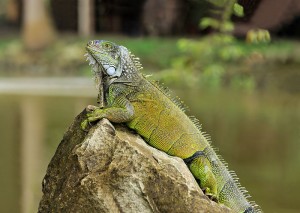
A wild female green iguana

Iguana iguana

Native range Central and South America and parts of the Caribbean
Invasive range Puerto Rico, US Virgin Islands, Florida, Texas, and Hawaii
Habitat Arboreal, often found near water.
Description With short legs and a long body that can reach up to 6 feet, iguanas are covered in short leathery scales. The tapered tail can be used as a weapon and for balance when climbing trees. Primarily herbivorous, an iguana’s spines are effective in defending against predation.


These days, a cold snap in Miami means a night when it rains iguanas. Down from sea grapes and buttonwood trees large, green, tree-dwelling invaders fall––because they’re native to warmer, more equatorial Central and South America. And there the lizards lie until the sun warms them up enough to move. It’s called “brumation,” the reptilian form of mammalian hibernation.
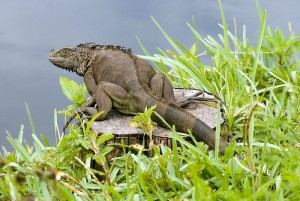
Blame the iguana invasion on the pet trade. The cute little salad-eaters with docile personalities make an easy sell. But then they grow up––to 6 feet long. They escape. Or they’re let loose by owners who can’t cope. They graze at the salad bar of the suburbs: shrubs, trees, orchids, figs, mangos, berries, tomatoes. They poop in or around water; a backyard swimming pool is perfect. They run into other iguanas in town. They breed. Their nest-burrowing digs up yards and undermines sidewalks, sea walls, and building foundations. They lay eggs––well, like reptiles, often in great numbers.
The Miami blue butterfly

That the Green Iguana is a herbivore is bad news for the endangered Miami Blue struggling to recolonize the Florida Keys: invading iguanas, having developed a taste for the nickerbean leaves where the blues lay their eggs, threaten to drive the butterfly into extinction.

If there is good news, it comes from Docteur André Nègre, author of The French West-Indies Through Their Cookery. Iguanas “feed themselves only on young vegetal shoots and on hibiscus flowers: no edible animal can boast of such a delicate food; man himself, if compared to this animal, eats filthy food, comparatively speaking.” R.P. Labat, in his Nouveaux Voyages aux Isles d’Amérique, 1722, reported that “The lizard’s flesh has the same whiteness, tenderness, exquisite taste and delicacy as the chicken’s.” In Florida, the domestic dog, the burrowing owl, and the raccoon concur as to its tastiness. It seems that only Anthony Bourdain disagrees.

What’s more, by papal decree long ago, the cold-blooded iguana, fond of warm coastal waters, can be eaten on Friday and during Lent.

They are probably too well in Florida to ever be eradicated, but they can be controlled and excluded on a local scale. Read more about one man’s efforts to rid Florida of the related spiny-tailed black iguana and Ctenosaur tacos at the South Beach Bar and Grille here.

University of Florida Extension’s profile of the iguana.

Recipes

To prepare an iguana for cooking
Skin and clean your gallina de palo the way you skin and clean a chicken, using the same best practices, since iguanas do carry salmonella.

Remove the head, organs, and entrails.

If you don’t want to skin it, dip it in hot water, then scrape the scales off as you do with fish.

Parboil in salted water for 20 to 30 minutes before roasting or stewing.

Rafael, of Pomuch, Mexico, explains how here.

Iguana Pozole

Pozole is a traditional hominy stew of Mexico.

Adapted from Gabriel Martinez Campos in Wikibooks.

2 medium iguanas
5 cups of freshly bleached hominy
10 cloves of garlic
1 onion
1 slice of cabbage, diced
bay leaf
Mexican oregano
salt and pepper

Butcher skin and cut the iguana in pieces. Wash, salt and blanch for 15 to 20 minutes.

Simmer the corn, garlic, onion, a bay leaf, and salt to taste.

At 10 minutes add the meat. Cook for another 15 to 20 minutes.

Serve with sliced cabbage, onion slices, cilantro, oregano, and pepper to taste.

Night of the Iguana

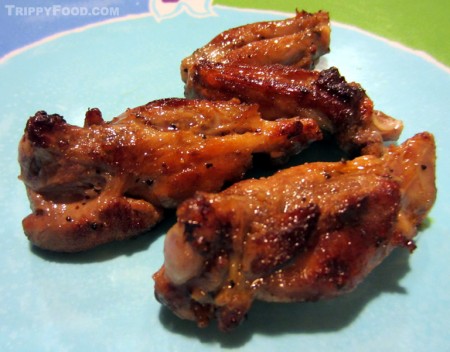
One fellow’s take on preparing iguana: if it tastes just like chicken, why not wings?
    Leave a Comment

    Land

    GarlicMustard1

    Blue Plate Special: Garlic Mustard

    It’s spring, and garlic mustard is sprouting up all over the East. Time to get out the food processor and pesto the invader.   Alliaria petiolata Native range: Europe, Asia, Northwest Africa Invasive range: Much of the Lower 48, Alaska, and Canada. (See map.) Habitat: Moist, shaded soil of floodplains, forests, roadsides, edges of woods, [...]


      EAT ME!
      burdoc87-l

      Burdock

      Native to the Old World, burdock’s introduction to North America was noted in 1672 by John Josselyn, a sharp-eyed English visitor, who used Gerard’s Herbal: The Historie of Plants of 1597 as a field guide. . . .


        EAT ME!
        Purslane close-up

        Purslane

        George Washington ate weeds. That is, he ate what he thought of as garden vegetables: Martha’s Booke of Cookery and Book of Sweetmeats, includes a handwritten recipe for Pickled Purslane. The manuscript . . .


          EAT ME!
          685px-Fallopia_japonica flower detail

          Japanese Knotweed

          It’s the 1880s. Frederick Law Olmstead, who, in his thirties, co-designed a little patch of ground in New York called Central Park, in his forties sells Boston on the Emerald Necklace, a whole new…


            EAT ME!
            Chopped dock whorls ready to be sauteed.

            Curly Dock

            Stare out across the empty lots and fields on the outskirts of Denver, Colorado, and you will see scattered clumps of dark green leaves towering above the grass. In spring the…


              EAT ME!

              Sea

              chuka wakame

              Wakame

                Undaria pinnatifida Native range: Japan Sea Invasive range: Southern California, San Francisco Bay, New Zealand, Australia, Europe, Argentina Habitat: Opportunistic seaweed, can be found on hard substrates including rocky reefs, pylons, buoys, boat hulls, and abalone and bivalve shells. Description: Golden brown seaweed, growing up to nine feet. Forms thick canopy. Reproductive sporophyll in [...]


                EAT ME!
                Hemigrapsus_sanguineus_big

                Asian Shore Crab

                The first sighting of the Asian shore crab in the United States was at Townsend Inlet, Cape May County, New Jersey, in 1988. Though the source is unknown . . .


                  EAT ME!
                  Periwinkles

                  Periwinkle

                  The common periwinkle, which first appeared in New England in the 1860s, is now found along the coast wherever there’s hard substrate–rocks, riprap, broken concrete, or docks–from Labrador to . . .


                    EAT ME!
                    Pterois volitans

                    Lionfish

                    Some say it started in 1992 in Miami when Hurricane Andrew smashed an aquarium tank. Don’t blame the weather, others say; in the mid-nineties, disappointed yet softhearted hobbyists…


                      EAT ME!
                      Kleiner_Taschenkrebs_(Carcinus_maenas)

                      Green Crab

                      Since the green crab was first recorded off southern Massachusetts in 1817, it has been hard to ignore. A few minutes of rock-flipping in Maine can turn up dozens of them, brandishing their claws as they retreat…


                        EAT ME!

                        Fresh

                        bullfrog

                        Bullfrog

                        “They live in a wide variety of habitats, colonize new ones readily, and eat everything that fits into their mouths,” says Dr. Peter Moyle of the Center for Watershed Sciences at UC-Davis…


                          EAT ME!
                          Distinguishing _ Channa argus

                          Northern Snakehead

                          His sister was ailing, and the man in Maryland remembered that, back home in Hong Kong, there was a fish that was considered a delicacy and a restorative. He would make a fish soup…


                            EAT ME!
                            Picture 1

                            Common Carp

                            For a bottom-feeder, what is the good life? The common carp isn’t very demanding: any body of water that’s sluggish and murky will do. One catching sewage or…


                              EAT ME!
                              nutria-mugshot

                              Nutria

                              Nutria, also known as coypu and river rat, is native to temperate and subtropical South America. It has been introduced to Europe, Asia, and Africa, mainly for fur farming. These voracious. . .


                                EAT ME!
                                Bighead_carp

                                Asian Carp

                                They can swim up the Mississippi River. They can fly over a fishing boat, ten feet in the air, hitting fishermen with the force of a bowling ball. They won’t take bait from hook, and they’re bony––what’s to like…


                                  EAT ME!

                                  Field Notes

                                  fish slider

                                  Pathways to Invasion

                                  How do invasive species enter North America? We bring them in. Our ancestors.The early colonists, brought pigs, which they let range free, and seeds to plant as crops. Others just hitched a ride: on their shoes, in fodder, on animals, on boat hulls, and stowed among ballast cobbles. Our tax dollars at work. Since the [...]


                                    EAT ME!
                                    Wildlife-Feral Hog

                                    Malicious but Delicious

                                    What should we eat to save local ecosystems and the future of civilization? Frank Bruni discusses a recent event in Austin, Texas, that served up feral hogs, tiger prawns, and Himalayan blackberries, in the New York Times.


                                      EAT ME!
                                      OLYMPUS DIGITAL CAMERA

                                      New Requirements for Ballast Water

                                      In a good move for our coastlines, the Environmental Protection Agency has issued new guidelines on ballast water. Incoming ships must continue dumping their ballast 200 miles from the U.S. shoreline, but they also must treat ballast water with ultraviolet light or chemicals to reduce the risk of transporting new invaders to the coast. Many [...]


                                        EAT ME!
                                        cbc

                                        Eat the Invaders in Cape Breton

                                        Steve Sutherland interviews Joe Roman about eating Maritime invaders on CBC Radio.


                                          EAT ME!
                                          Screen Shot 2012-12-21 at 10.55.23 AM

                                          Invasive Species Cook-off in Oregon

                                          Earlier this year, the Institute for Applied Ecology held a cook-off for invaders in Corvalis. Dave Budeau won with his pulled smoked nutria. Read more about the event and the institute here.


                                            EAT ME!

                                            “Foraging is treasure hunting.”

                                            René Redzepi, owner of Noma, twice named best restaurant in the world

                                            Previous post:

                                            Next post: